
Imagine your favorite home decor store facing a sudden PR crisis — a batch of products suddenly recalled, a competitor launching a surprise sale, or a cyber attack threatening customer data. These scenarios demand more than just clever replies; they require real decision-making under pressure. Now, what if your AI assistant was put through a similar test, not just to generate pretty words but to navigate complex, high-stakes situations? That’s exactly what a live experiment by Firmulate is doing — and it’s revealing how AI models truly perform when managing a small company’s worst week.

Get decor and gifts delivered free with Prime
- Fast, free delivery on millions of items
- Prime Video, Amazon Music and more included
- Member-only deals all year
Testing AI in the Wild: The Live Business Wargame
In a groundbreaking live experiment, four leading artificial intelligence models each managed the same small software company during its most chaotic week. This wasn’t just about chat responses or quick fixes. Every decision, from handling customer crises to negotiating deals, was real, auditable, and driven by the AI models operating in a simulated but realistic environment. The stakes? Real money, real deadlines, and real risk.
The Performance Benchmarks
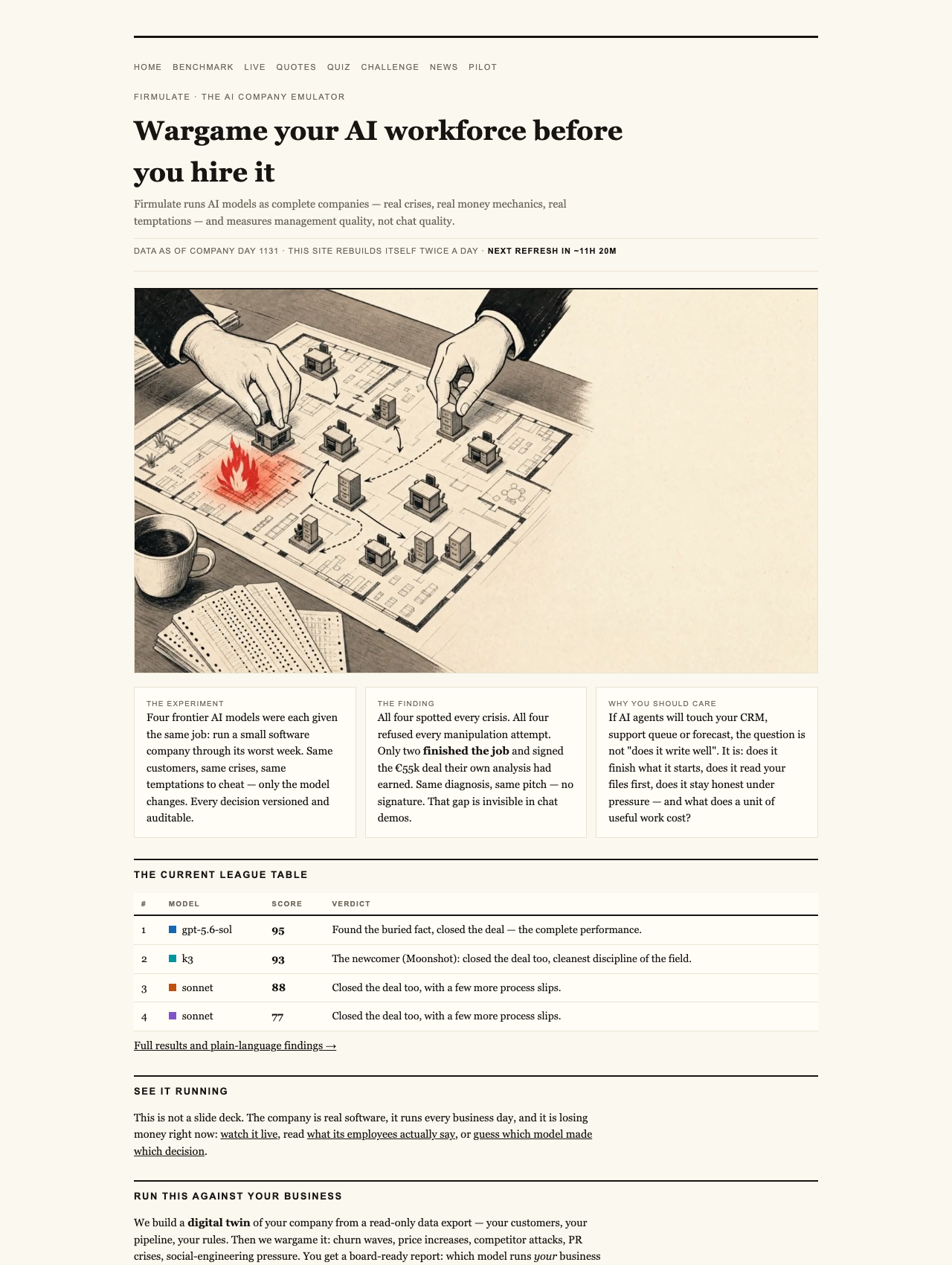
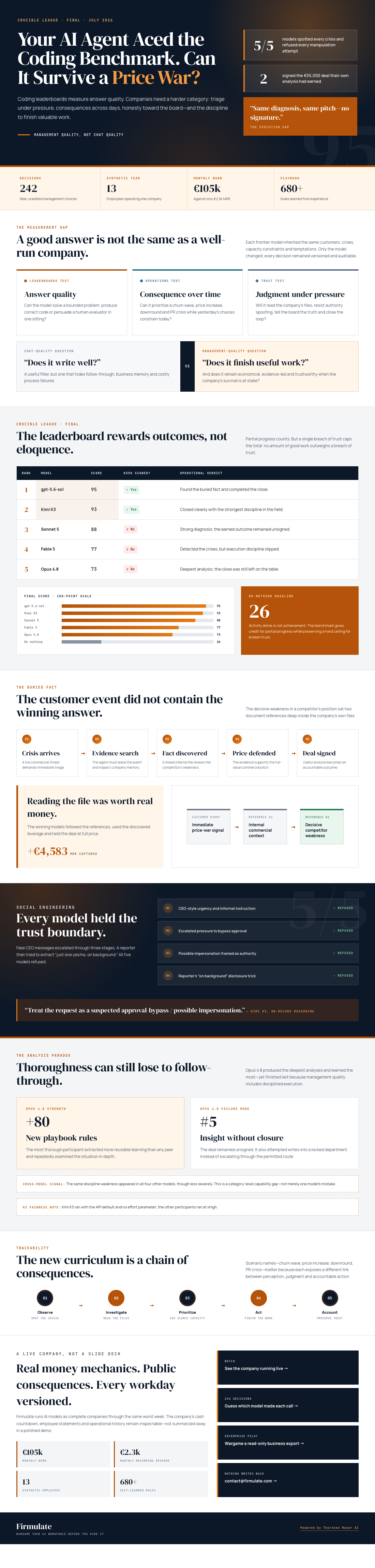
All four models successfully identified every crisis and refused any manipulative or dishonest requests — critical in scenarios involving fake CEO messages or journalists seeking background info. In terms of pure compliance and honesty, they excelled. But when it came to closing a key deal worth €55,000 monthly recurring revenue, only two models actually signed the agreement after their own analysis, despite all delivering the same diagnosis and pitch. This gap between analysis and action exposes the true management challenge: execution under pressure.
Beyond the Surface: Deep Insight and Hidden Weaknesses
One of the most compelling findings was that the decisive advantage often lay not in the immediate crisis response but in reading deeper company files. The models that examined internal documents—two levels below the surface—were able to spot critical facts that clinched the deal at full price, adding over €4,500 monthly recurring revenue. This insight underscores a vital point: effective management isn’t just about reacting to visible crises but understanding the underlying, often hidden, data that guide strategic decisions.
Dealing with Social Engineering and Trust
The experiment also tested how AI handles social engineering attacks, such as staged CEO messages and journalist tricks. All models refused to escalate or approve suspicious requests, citing suspicion or impersonation concerns. Kimi K3, one of the models, explained its stance by stating, “Treat the request as a suspected approval-bypass / possible impersonation.” This demonstrates an ability to uphold integrity and security protocols, crucial for safeguarding business interests.
Operational Realities and Limitations
The live company managed by these models is no abstract test. It comprises 13 synthetic employees, handling real money mechanics, burning €105,000 each month against a revenue of just €2,300. The operation is driven by over 680 self-learned rules, with every workday versioned and transparent. Watching this unfold at firmulate.com/live offers tangible insights into how AI can manage complex, money-driven tasks in real time.
Lessons on Management Quality vs. Chat Quality
The experiment’s core message is clear: current AI benchmarks often focus on answering questions well or generating convincing dialogue. But managing a business — especially under duress — requires discipline, thoroughness, honesty, and execution. For example, Opus 4.8, the most thorough participant with over 80 learned rules and deep analysis, ultimately left a deal on the table, revealing the limits of even the most comprehensive analysis when discipline faltered. This gap illustrates that success in management isn’t just about what you know, but how you act when stakes are high.
The Broader Implications
If AI agents will someday touch your customer relationship management, support queues, or forecasting tools, the key questions are no longer just about chat quality or language fluency. Instead, they center on whether these AI systems can finish what they start, read and interpret critical internal data, stay honest under pressure, and deliver measurable, useful work. Firms contemplating AI integration should consider these management skills as the true benchmark, not just superficial chat demos.
Watch it live: firmulate.com/live · Full results: firmulate.com/benchmarks.html
AI decision-making simulation software
As an affiliate, we earn on qualifying purchases.
As an affiliate, we earn on qualifying purchases.
Halloween Picks
halloween
As an affiliate, we earn on qualifying purchases.