
TL;DR

Get decor and gifts delivered free with Prime
- Fast, free delivery on millions of items
- Prime Video, Amazon Music and more included
- Member-only deals all year
A Livingetc report outlines Norwegian designer Gudbjørg Simonsen’s approach to lighting homes through short winter days: design for seasonal change, use layers of light and allow shadow rather than aiming for uniform brightness. The advice is design guidance, not a formal lighting standard, and the report does not provide measured evidence of effects on mood or health.
Livingetc has published winter-lighting advice from Norwegian designer Gudbjørg Simonsen, who says homes should be designed for seasonal changes rather than kept uniformly bright. Her recommendations include layering functional and decorative lighting, using contrast and shadow, and considering how a room should feel as well as what people need to see.
Simonsen, who is based in Stavanger, Norway, says a home’s lighting should respond to changing daylight across the year. The report presents her approach as a response to Norway’s seasonal shifts: in December, it says, daylight can last up to six hours in parts of the country, while the far north can experience periods without daylight. The source does not give a specific location or calculation method for those figures.
For Simonsen, lighting has both a practical and an emotional role. It can help people carry out tasks, but also shape a room’s atmosphere and sense of welcome. She says that seeing a warmly lit window on a dark winter evening can suggest that someone is home. That is her interpretation of the experience, rather than a research finding presented in the report.
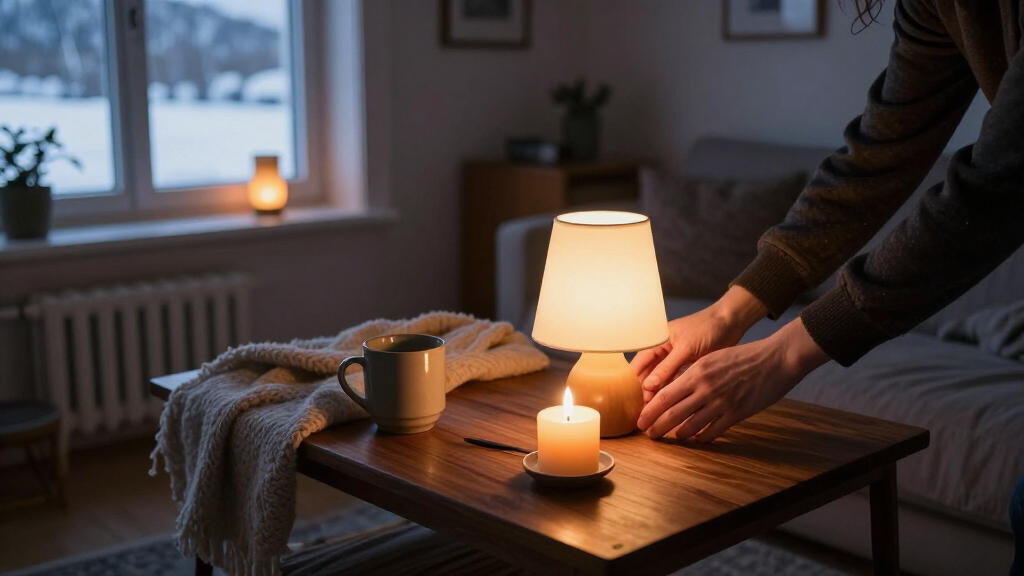
One of her main recommendations is to avoid trying to illuminate every part of a room equally. She says variation matters: brighter areas, gradual changes in light and some shadow can make an interior feel less flat. The report also recommends layering different kinds of lighting. Its quoted advice begins with functional or technical light—for example, illumination over a work surface, a route through a room, or a piece of art—and favors discreet or integrated fittings when the light source itself need not be prominent.
Lighting for Short Winter Days
The advice matters to readers planning how their homes will feel and function when daylight is limited. A single bright overhead light may meet some visibility needs, but Simonsen’s approach asks homeowners to consider separate purposes: task lighting for practical work, alongside softer sources that contribute to a room’s atmosphere. This can help people think more deliberately about how they use a space at different times of day.
Her emphasis on shadow also offers an alternative to treating every dim corner as a problem to eliminate. The report’s point is not that homes should be dark, but that contrast and varied light can be part of a considered design. The source offers professional guidance and personal observations; it does not establish that a particular lighting plan will improve mood or health, or prescribe a universal solution.
Norwegian style layered home lighting
As an affiliate, we earn on qualifying purchases.
As an affiliate, we earn on qualifying purchases.
A Designer Shaped by Norway’s Seasons
The Livingetc report places Simonsen’s advice in the context of Norway’s substantial seasonal changes in daylight. It says her design work takes account of the environment around a home and the lifestyle of the people living in it, as well as her interest in traditional Norwegian architecture. The article contrasts Norwegian winter conditions with those in the UK, but its figures are broad and not broken down by city or date.
Rather than treating winter lighting as a separate fix, Simonsen describes a home as changing character through the seasons. In her view, light, shadow, color and materials are experienced differently as daylight changes. The report therefore frames lighting as one part of a wider design approach, not simply a matter of selecting brighter bulbs.
“I don’t think we can design homes as though light remains constant throughout the year. Nor do I think the answer is to fight the darkness. We have to design with it.”
— Gudbjørg Simonsen, Norwegian designer, as quoted by Livingetc
What the Advice Does Not Establish
The supplied report does not identify its publication year, provide a full product specification or set out a complete lighting plan with bulb types, brightness levels or costs. The source material ends partway through Simonsen’s discussion of layered lighting, so it does not include the full set of recommendations that may appear in the original article.
Nor does the report cite studies measuring the effects of these design choices on mood, sleep or health. Its claims about warmth, welcome and the feeling of a space are attributed to Simonsen’s professional perspective. The daylight figures are not accompanied by geographic detail, so they should not be read as applying uniformly across Norway.
Applying the Ideas at Home
Readers can start by identifying what each area of a room needs: light for work or reading, light that helps people move safely through the space, and softer sources for the hours when a welcoming atmosphere is the priority. Simonsen’s quoted guidance favors keeping technical fittings discreet where practical, while using light to direct attention to a work surface, an artwork or a route through a room.
The report does not announce a product launch, policy change or scheduled follow-up; it offers design advice. Any specific choices will depend on a home’s layout, daylight, activities and existing fixtures. The next step for readers is to assess how their own rooms are used during darker months, then decide whether additional or repositioned light sources would meet those needs.
Key Questions
What is the main lighting advice in the Livingetc report?
Designer Gudbjørg Simonsen recommends designing for seasonal changes, using layers of functional and atmospheric light, and allowing variation and shadow rather than lighting every part of a room evenly.
Why does Simonsen say light is more than a practical tool?
She says lighting affects how a room feels as well as how well people can see. In the report, she describes a warmly lit window on a dark evening as a sign of human presence and welcome.
Does the report say every room should be dim in winter?
No. The advice is to avoid uniform illumination as the only approach, not to leave rooms inadequately lit. The report describes combining practical light with varied sources and allowing some shadow.
Does the article provide scientific evidence that this lighting improves mood?
No such evidence is cited in the supplied source. The comments about atmosphere and feeling are attributed to Simonsen as a designer, not presented as measured health findings.
Source: rss
Halloween Picks
halloween
As an affiliate, we earn on qualifying purchases.