
TL;DR

Get decor and gifts delivered free with Prime
- Fast, free delivery on millions of items
- Prime Video, Amazon Music and more included
- Member-only deals all year
A report by Ideal Home describes transition trees: trees decorated for autumn or Halloween, then updated for Christmas and potentially New Year. Interior experts say the approach can extend the use of seasonal decorations, though its popularity as a defined trend remains uncertain.
Ideal Home has reported on transition trees, a seasonal decorating approach in which one tree is updated from autumn or Halloween through Christmas and, potentially, New Year. The idea gives households an alternative to taking decorations down and starting again for each holiday, although the report does not establish how widely the style is being adopted.
The approach can use an artificial Christmas tree put up early or a more understated twig tree. Decorations change as the season progresses: autumn foliage and pine cones can give way to richer colors, lights and festive ornaments. For Halloween, interior designer and trends forecaster Whinnie Williams suggests using items such as toy spiders and webs, or adapting existing decorations into ghosts.
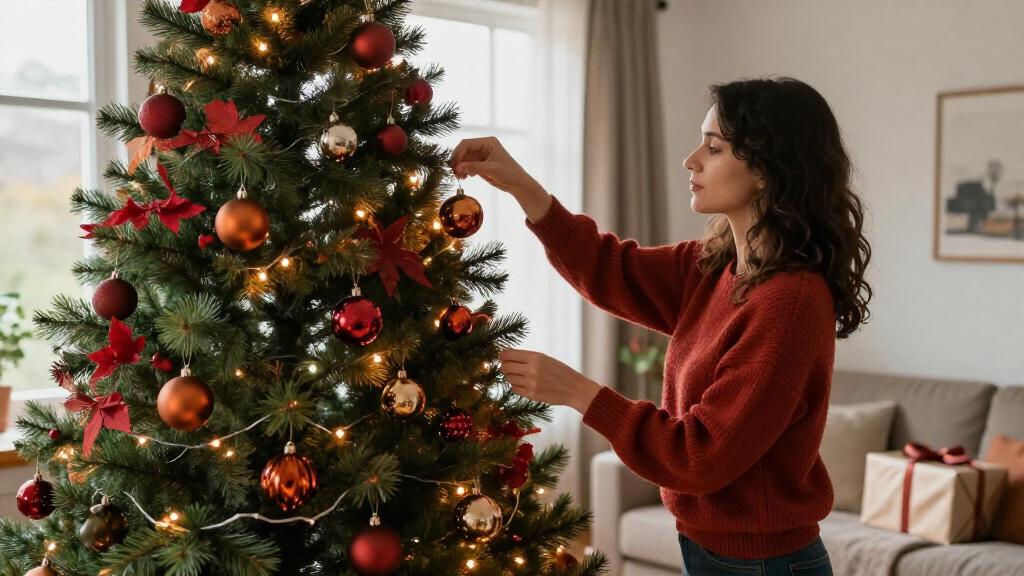
For a look that can carry through November, Williams recommends deep reds such as burgundy, which can work with gold and feel appropriate for both autumn and Christmas. Another option is to retain a natural palette with foliage, faux berries, pine cones and ribbons in red, orange and brown, then introduce lights and metallic accents gradually.
Victoria Robinson, a trend expert at Hillarys, says the same tree can become a focal point throughout the darker months. She recommends building the decoration through texture and layered details, rather than relying only on color. Near the end of the season, Williams suggests removing the baubles and leaving the lights on for a simpler New Year display.
One Tree, Several Seasonal Looks
For readers who decorate for more than one autumn and winter occasion, a transition tree offers a way to reuse a central display instead of replacing it entirely. The practical appeal is adaptability: a few changes to ornaments can shift the same tree from a Halloween look to a Christmas scheme, which may help households make more use of decorations they already own.
The idea also reflects a broader decorating preference described by Robinson: choosing pieces that can be styled in different ways and kept in use longer. That is an expert’s assessment of the direction of home decorating, not evidence that transition trees have already become a widely established trend. The source notes that Halloween trees have become more popular, while saying transition trees are not yet a trend on the same level.
artificial Christmas tree with interchangeable ornaments
As an affiliate, we earn on qualifying purchases.
As an affiliate, we earn on qualifying purchases.
From Halloween Through New Year
The decorating calendar in the report begins before Christmas, with autumn and Halloween increasingly treated as occasions for seasonal displays. A gap can follow when Halloween decorations come down but Christmas decorating feels premature. The transition-tree concept addresses that interval by making the display evolve rather than starting over.
Ideal Home presents the idea as a decorating recommendation, drawing on comments from Robinson and Williams. Its examples include a small artificial tree, a twig tree and ornaments that can be swapped over time. The article also mentions leaving lights on after removing baubles for New Year. It does not provide sales figures, survey data or a measured timeline for the trend’s adoption.
“One of the biggest benefits of a transition tree is that it helps create a sense of occasion throughout the darker months.”
— Victoria Robinson, trend expert at Hillarys
How Far the Trend Has Spread
The scale of adoption is unclear. The report calls transition trees a potential next step and says they are not yet trending, but it offers no consumer data to show how many households use them. Its examples are recommendations from decorating experts, not evidence that a new national trend has been confirmed.
The source also does not quantify potential savings or explain how much time or expense households might save by reusing a tree. Whether the approach suits a home depends on available space, existing decorations and personal preferences. No specific product availability or pricing is established as part of the trend itself.
How the Display Can Change
Under the approach described, households can start with autumn colors and natural ornaments, add Halloween details if desired, then introduce lights, metallic accents and richer jewel tones as Christmas approaches. After Christmas, they can remove ornaments while keeping the lights for a New Year display. Each stage is optional; the report presents a flexible decorating idea, not a fixed schedule or required set of purchases.
For readers considering the style, the next step is choosing a tree and decorations that can work across more than one season. The source offers no announced follow-up or forecast date for wider adoption, so whether transition trees become a lasting trend remains to be seen.
Key Questions
What is a transition tree?
A transition tree is a tree whose decorations are changed over the autumn and winter, moving from an autumn or Halloween look to Christmas and possibly New Year.
What kind of tree can be used?
The report suggests either a small artificial Christmas tree or a more subtle twig tree. The choice depends on the look and space available.
How can a tree move from Halloween to Christmas?
Start with autumn foliage, pine cones or Halloween ornaments, then swap or add details such as burgundy decorations, gold accents, fairy lights and festive baubles as the season changes.
Is a transition tree already a widespread trend?
The report does not establish that. It says Halloween trees have grown in popularity and describes transition trees as a possible next step, but provides no adoption figures.
Can the tree be used after Christmas?
Yes. Williams suggests taking off the baubles but leaving the lights on for a simpler New Year display.
Source: rss
Halloween Picks
halloween
As an affiliate, we earn on qualifying purchases.