The history of Valentine’s Day poetry dates back to ancient Greece and Rome, where love was celebrated through hymns and songs. During the Middle Ages, love poetry became more personal with courtly love and allegories, influenced by poets like Dante. Over time, handwritten love letters and sonnets took center stage, evolving into modern digital messages and social media posts. If you want to explore how these changes shaped today’s romantic expressions, there’s more to discover.

Get decor and gifts delivered free with Prime
- Fast, free delivery on millions of items
- Prime Video, Amazon Music and more included
- Member-only deals all year
Key Takeaways
- Valentine’s Day poetry has roots in medieval love poetry, emphasizing courtly love, devotion, and chivalry through allegorical and lyrical styles.
- Early poets like Dante and troubadours popularized poetic expressions of love, inspiring romantic themes associated with Valentine’s Day.
- The tradition shifted from formal poetic compositions to handwritten love letters, making personal expressions central to Valentine’s celebrations.
- Romantic poetry’s use of metaphor, imagery, and themes of longing influenced how love was expressed on Valentine’s Day through history.
- In modern times, digital media and personalized messages continue the tradition, blending poetic sentiment with contemporary technology.
As an affiliate, we earn on qualifying purchases.
Origins of Romantic Verse in Ancient Cultures

Many ancient cultures celebrated love through poetry, laying the groundwork for Valentine’s Day traditions. You can see this in the works of the Greeks and Romans, where poets expressed admiration and longing through lyrical verses. The Greeks honored Aphrodite, the goddess of love, with hymns that praised beauty and desire. Romans, meanwhile, celebrated love in festivals like Lupercalia, where poetry and songs played a role in courtship. These early expressions of romantic feeling helped establish the idea that love deserves special words and attention. As these cultures evolved, so did their poetic traditions, emphasizing emotional connection and admiration. The historical significance of love poetry created a foundation that would influence future generations’ ways of expressing affection through verse. The use of poetic forms from these ancient societies reflects their deep appreciation for love’s expressive power. Additionally, the cultural impact of these poetic traditions can still be seen in modern romantic expressions.
The Evolution of Love Poetry in the Middle Ages
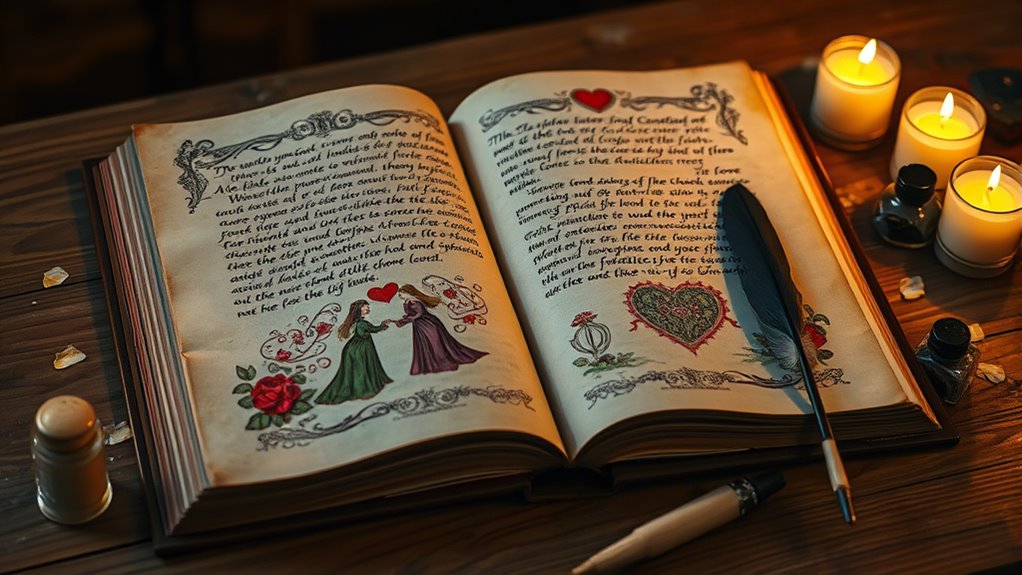
During the Middle Ages, love poetry became closely linked to courtly love traditions, emphasizing devotion and chivalry. You’ll notice new poetic forms and styles that express longing and admiration in subtle, refined ways. Many notable poets shaped this era’s poetic landscape, influencing future expressions of love. The use of poetry forms and stylistic techniques during this period laid the groundwork for more expressive and nuanced love poetry in subsequent eras. Additionally, the development of vernacular poetry allowed for broader accessibility and emotional depth in poetic expressions of love. The incorporation of metaphorical language further enriched the emotional impact and complexity of medieval love poetry. Embracing cultural intelligence principles, poets adapted their works to resonate with diverse audiences, enhancing the universality of their love expressions. Recognizing the importance of literary innovation, poets experimented with new themes and structures to deepen the emotional connection with their readers.
Courtly Love Traditions
The Middle Ages saw the rise of courtly love, a highly stylized form of romance that deeply influenced love poetry. You’d find that poets expressed admiration and desire through refined language, often emphasizing the knight’s devotion to an idealized lady. This tradition created a code of conduct where love was seen as noble, respectful, and sometimes secret. Poets used allegories and metaphors to convey feelings that couldn’t be openly expressed, emphasizing virtues like humility, loyalty, and longing. You’d notice that the beloved was often portrayed as an unattainable muse, inspiring poetic devotion. Courtly love fostered a sense of emotional refinement, shaping the way love was celebrated in poetry and setting standards that persisted for centuries. Additionally, the emphasis on emotional connection helped to elevate poetry as a form of personal and spiritual expression during this period. The use of symbolism and allegory further enriched the poetic language, allowing writers to convey complex emotions subtly and artistically.
Poetic Forms and Styles
As love poetry evolved in the Middle Ages, poets experimented with a variety of poetic forms and styles to express their devotion and longing. They embraced structured forms like the sonnet, which allowed them to explore themes of desire within strict rhyme schemes and meters. The troubadours and minstrels favored lyric poetry, often using simple, musical language to evoke emotion. The allegorical and moralistic styles also gained popularity, blending love with spiritual or philosophical ideas. During this period, poets balanced ornate language with clarity to captivate their audience. They adapted classical influences while developing new techniques suited to expressing complex feelings. These innovations laid the foundation for the rich variety of love poetry that would follow, shaping how love was celebrated through verse. Additionally, the poetic forms of the Middle Ages reflected broader cultural and philosophical shifts, emphasizing personal expression and spiritual reflection in love poetry. The use of metaphorical language further enriched the expressive power of medieval love poetry, allowing poets to convey nuanced emotions indirectly. Moreover, the integration of musical elements into poetry enhanced its emotional impact and memorability. Furthermore, the influence of Heidegger’s authenticity can be seen in medieval poetry’s pursuit of genuine emotional expression, emphasizing sincerity over superficial beauty.
Notable Medieval Poets
Medieval poets played a crucial role in shaping the evolution of love poetry, blending inspiration from classical traditions with innovative approaches to express desire and devotion. You’ll find poets like Guillaume de Lorris and Jean de Meun, who crafted the influential *Roman de la Rose*, which explores courtly love through allegory. Dante Alighieri’s *Vita Nuova* combines personal passion with poetic innovation, emphasizing love’s spiritual dimensions. Meanwhile, troubadours such as Bernart de Ventadorn popularized lyric poetry focused on chivalric love, often performed in courts. These poets pushed boundaries, transforming love poetry into a refined art form that celebrated both earthly passion and spiritual longing. Their work laid essential foundations for later centuries, influencing how love would be expressed poetically across eras. Additionally, the development of poetry forms during this period provided new ways for poets to articulate complex emotional and spiritual experiences, often utilizing metaphorical language to deepen the expressive power of their verses, contributing to the rich literary tradition of love poetry. The integration of innovative techniques further expanded the expressive possibilities of medieval love poetry, allowing poets to explore new thematic and stylistic horizons, such as the use of conceits and elaborate allegories.
Shakespeare’s Influence on Valentine’s Day Verse
Shakespeare’s work has profoundly shaped Valentine’s Day poetry, transforming how love is expressed through verse. His sonnets set a standard for romantic language, blending passion and wit. You can see his influence in the way poets today use vivid imagery and emotional depth. Shakespeare introduced themes of longing, beauty, and fidelity that remain central to love poetry. His clever wordplay and metaphors inspire writers to craft more expressive and heartfelt messages. Additionally, his mastery of poetic form has established enduring conventions for composing love verse. His innovations in metaphor and imagery continue to influence the way love is described in poetry. The use of romantic themes in his poetry has set a benchmark for subsequent generations of poets. Furthermore, his exploration of universal emotions has helped poets connect on a deeper level with their audience. His ability to evoke timeless sentiments makes his work a lasting source of inspiration for romantic verse. Below is a table highlighting some key elements of his influence:
| Element | Description |
|---|---|
| Sonnet Structure | Popularized the 14-line form for love poetry |
| Imagery | Rich metaphors for beauty and love |
| Themes | Eternal love, longing, and idealized beauty |
| Language | Witty, expressive, and poetic diction |
The Rise of Personal Love Letters and Poems

You notice how romantic expression shifted from formal poetry to personal love letters. Handwritten notes became a heartfelt way to share feelings directly with someone special. This sentimentalism helped deepen emotional connections during Valentine’s Day celebrations. Additionally, the tradition of exchanging heartfelt messages continues to thrive, especially with the availability of special event hours, making it easier to celebrate love year-round. The evolution of celebrity relationships highlights how personal expressions of affection remain a timeless aspect of romance.
Romantic Expression Evolution
How did lovers convey their deepest feelings before the age of instant communication? They turned to handwritten letters and poems, crafting heartfelt messages to express love. These personal tokens became treasured keepsakes, filled with emotion and sincerity. Over time, this tradition evolved into more elaborate poetic forms, emphasizing personal connection. To illustrate this shift, consider the following:
| Era | Method of Romantic Expression |
|---|---|
| Medieval | Love sonnets and poetic exchanges |
| Renaissance | Secret love letters and poetic dedications |
| 18th Century | Personalized poetry and verses |
| Victorian Era | Intimate handwritten notes and poems |
| Modern Day | Digital messages and personalized poems |
This evolution highlights how love’s expression became more intimate and personalized, shaping the romantic poetry we cherish today.
Handwritten Sentimentalism
During the rise of personal love letters and poems, handwritten words became the most heartfelt way you could express your deepest feelings. You carefully selected your paper, poured emotion into each stroke, and crafted messages that revealed vulnerability and affection. This intimate act allowed you to communicate love beyond spoken words, capturing your genuine sentiments in a lasting form. Handwritten notes became cherished keepsakes, treasured long after the moment. As you penned your thoughts, you created a personal connection that typed messages couldn’t match. The imperfections and unique handwriting added authenticity, making each letter special. This sentimental practice transformed love expressions into timeless artifacts, emphasizing sincerity and emotional depth that defined romantic gestures for generations.
Modern Trends and Digital Expressions of Love

In recent years, digital platforms have transformed how people express love, making romance more immediate and accessible. You now share heartfelt messages through texts, social media posts, and emojis, often replacing traditional poetry. These digital expressions create instant connections, allowing you to celebrate love anytime.
| Method | Impact |
|---|---|
| Text messages | Personal, direct, and quick |
| Social media posts | Public declarations reach wider audiences |
| Emojis | Enhance tone and emotion instantly |
| Digital cards | Customizable and eco-friendly |
| Video messages | Intimate and personal |
This shift means your love can be celebrated with a tap or click, blending creativity with convenience in modern romance.
The Cultural Significance of Valentine’s Day Poetry Today

Although digital communication has changed how you express love, Valentine’s Day poetry still holds deep cultural significance today. It remains a powerful way to convey genuine emotion beyond emojis and texts. When you write or read a heartfelt poem, you connect on a deeper level, emphasizing sincerity and vulnerability. Many people see Valentine’s Day poetry as a timeless tradition that celebrates love’s complexity and beauty. It encourages you to reflect on your feelings and express them thoughtfully. Even as trends shift, poetry keeps the romantic spirit alive, reminding you of love’s enduring importance. Sharing poetry today continues to foster intimacy and tradition, making Valentine’s Day more meaningful across generations. It’s a reminder that words still carry immense emotional weight.
Frequently Asked Questions
How Did Valentine’S Day Become Associated With Romantic Poetry?
Valentine’s Day became linked to romantic poetry because lovers started expressing their feelings through verse to celebrate love. You might imagine poets like Chaucer or Petrarch writing heartfelt lines for their beloveds, inspiring others to do the same. Over time, sharing poetry on Valentine’s Day became a tradition, as people wanted to beautifully convey their affection and admiration, making poetic expressions a key part of celebrating romance on this special day.
What Are Some Famous Poets Known for Valentine’S Day Verse?
Imagine love’s voice whispering through poetry—who better to hear it from than famous poets? You’ll recognize William Shakespeare, whose sonnets capture eternal romance, and Elizabeth Barrett Browning, with her passionate “How Do I Love Thee?” Then there’s Pablo Neruda, whose verses sing of love’s deep hues. These poets make Valentine’s Day a celebration of heartfelt words, turning simple feelings into timeless poetry that stirs your soul.
How Have Cultural Differences Influenced Love Poetry Worldwide?
You’ll notice that cultural differences shape love poetry in powerful ways. In some traditions, poetry emphasizes passionate longing and direct expression, while others focus on subtlety and poetic metaphor. You might find Asian poetry highlighting harmony and spiritual connection, whereas Western works often celebrate romantic love and individual emotion. These variations reflect each culture’s values, beliefs, and language styles, making love poetry a diverse and rich reflection of human relationships worldwide.
What Role Did Poetry Play in Courtship Rituals Historically?
You see, poetry played a crucial role in courtship rituals historically. It allowed you to express your feelings creatively and romantically, often serving as a private message of love. Poets and lovers used verses to flatter, impress, and communicate emotions that words alone sometimes couldn’t fully convey. Engaging in poetic exchanges helped build emotional connections, making the pursuit of love more intimate and meaningful in many cultures.
How Is Valentine’S Day Poetry Celebrated in Contemporary Society?
Imagine a world where every love note is a masterpiece, and Valentine’s Day poetry floods the streets like a tidal wave of emotion! Today, you celebrate by writing heartfelt poems, sharing them in cards, or posting them online. You might even attend poetry readings or create romantic verses with friends. This day transforms simple words into powerful expressions of love, making every heart feel the magic of poetry’s timeless charm.
Conclusion
As you explore the history of Valentine’s Day poetry, you realize it’s like a river flowing through time, shaping love’s expression with each bend and turn. From ancient chants to digital emojis, these verses are the bridges connecting hearts across centuries. Embrace this poetic journey, knowing your words carry the timeless power to ignite passion and forge bonds. Love’s language remains an ever-evolving masterpiece, waiting for you to add your unique stroke.
Halloween Picks
halloween
As an affiliate, we earn on qualifying purchases.