
TL;DR

Get decor and gifts delivered free with Prime
- Fast, free delivery on millions of items
- Prime Video, Amazon Music and more included
- Member-only deals all year
A Hunker report describes reusing old cake pans as molds for customized concrete pavers, offering an alternative to buying specialty forms for small projects. The method involves concrete mix, a release coating and basic protective equipment, but the report does not provide tested durability results or a standard paver thickness.
Old cake pans can be reused as molds for custom concrete pavers, according to a Hunker report describing a low-cost option for people making a small garden path or decorative stepping stones. The approach can avoid the cost of specialty molds, though the report does not establish how well pavers made this way hold up under repeated use or different weather conditions.
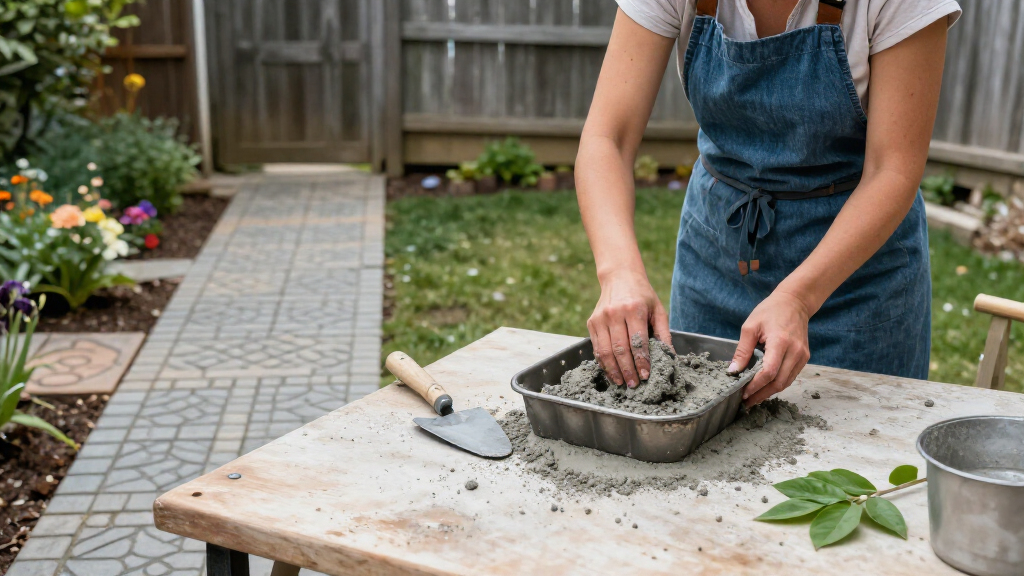
The reported method uses a cake pan, a release coating such as baking spray or petroleum jelly, and an all-purpose concrete or stepping-stone mix. The concrete is mixed with water according to the product instructions, poured into the prepared pan, and left on a level, protected surface to set. Once hardened, the edges can be loosened to release the paver. Hunker notes that aluminum and silicone pans may both be used, and that pan shape and depth affect the finished design.
Simple round or square pans can make familiar stepping stones, while scalloped or novelty shapes allow more varied outlines. Decorative additions such as river rocks, seashells or gemstones can be arranged in the pan before pouring, or pressed into the top of wet concrete. The report also describes concrete pigment as an option for adding color. It cautions that intricate pans may make removal more difficult, so the process may require experimentation.
Hunker advises wearing work gloves, eye protection and a mask or respirator when handling dry concrete mix, whose dust can irritate. It also warns that decorations with sharp edges, slippery surfaces or raised profiles may create hazards if the pavers are used as a walking surface. For functional stepping stones, the article says the pieces should be large and thick enough to support a person without cracking, but gives no measurements or engineering guidance.
A Low-Cost Option for Small Paths
For a homeowner or renter making only a few decorative stones, reusing a pan already on hand could reduce the need to buy a dedicated mold. The approach also offers more choice in shape than many basic mold kits, according to Hunker. That may suit a small garden project where the appearance and individual design matter as much as uniform sizing.
The trade-off is that cake pans are not necessarily designed for casting concrete. A release coating may not work equally well on every pan, and detailed shapes can make demolding harder. A homemade paver intended for a path also needs to be stable and safe underfoot; decorative materials that sit above the concrete or become slippery could make a walking surface less suitable. The report presents a craft method, not a tested product specification.
Popular right now

Bose QuietComfort True Wireless Earbuds with Active Noise Cancellation, Black

Dyson V8 Cyclone Cordless Vacuum

KitchenAid Artisan Series 5-Quart Tilt-Head Stand Mixer, Dried Rose (KSM150PS)
As an affiliate, we earn on qualifying purchases.
From Baking Tin to Concrete Mold
The Hunker article frames cake pans as a substitute for purchasing specialty concrete molds, which can be expensive when someone needs only a small number of pieces. The suggested project uses ordinary household or thrift-store pans and common concrete supplies. Rather than limiting the result to standard squares or faux-rock shapes, the pan itself determines the paver’s outline.
The source describes a sequence of preparation, mixing, pouring and curing, but does not provide a specific curing duration. It tells readers to follow the concrete manufacturer’s instructions for mixing and to protect the filled pans while the concrete sets. This matters because product directions and conditions can vary; the report does not offer a universal recipe for all mixes or pan designs.
Durability and Fit Remain Untested
The supplied report does not provide independent testing, load limits or a recommended minimum thickness for pavers made in cake pans. It also does not specify how long the concrete should cure before use, how the finished stones perform in freezing or wet conditions, or whether a particular pan material is easier to release consistently. Those questions depend on the concrete product, dimensions, placement and local conditions.
Hunker mentions WD-40 and coconut oil as alternatives that some DIYers recommend when baking spray or petroleum jelly does not release the concrete easily. The report does not establish which coating works best or assess possible effects on the concrete or pan. Readers should treat these as suggested experiments, not a verified requirement. It is also unclear whether the resulting pieces would be appropriate for high-traffic areas; the article focuses on small DIY pavers and decorative accents.
Test One Paver Before Scaling Up
Anyone considering the project can start with a single pan and follow the chosen concrete mix’s directions, using protective equipment while handling dry material. After the concrete has set and the piece is removed, check whether the pan releases cleanly and whether the paver is level, intact and suitable for its intended location. A small test can reveal problems with the mold shape or release coating before more material is used.
For stones people will walk on, assess whether decorative elements are flush and provide a stable surface, and avoid sharp or slippery additions. The supplied report gives no formal safety standard or design dimensions, so it cannot confirm that every cake-pan mold will produce a durable path stone. The next practical step is to evaluate the test piece and consult the concrete manufacturer’s instructions before making more.
Key Questions
Can any old cake pan be used as a concrete paver mold?
Hunker says many shapes may work and specifically mentions aluminum and silicone pans. It does not test every material or design, and intricate pans may make it harder to remove the concrete without damage.
What supplies does the project require?
The report lists a cake pan, baking spray or petroleum jelly, concrete mix, a bucket, a shovel or mixing attachment, and water. It also recommends gloves, eye protection and a mask or respirator for handling dry mix.
How can the pavers be decorated?
Small stones, shells or gemstones can be placed in the mold before pouring, or pressed into the wet concrete. Concrete pigment is another option. Avoid decorations that are sharp, slippery or raised above the surface if people will walk on the pavers.
How thick should a cake-pan paver be?
The Hunker report does not give a measurement. It says pavers intended for walking should be large and thick enough to support a person without cracking; the right dimensions are not established in the supplied material.
How long should the concrete cure before use?
The report does not specify a curing time. Follow the instructions for the concrete product being used rather than assuming that all mixes or conditions require the same setting period.
Source: hunker.com